
Payment Options
 Cash App
 Apple Pay
 PayPal
 Crypto (USDC)
$10 USPS Priority Shipping
Estimated delivery: 2–5 business days. Delivery times may vary.
Orders of $500 or more ship free. Final shipping details at checkout.
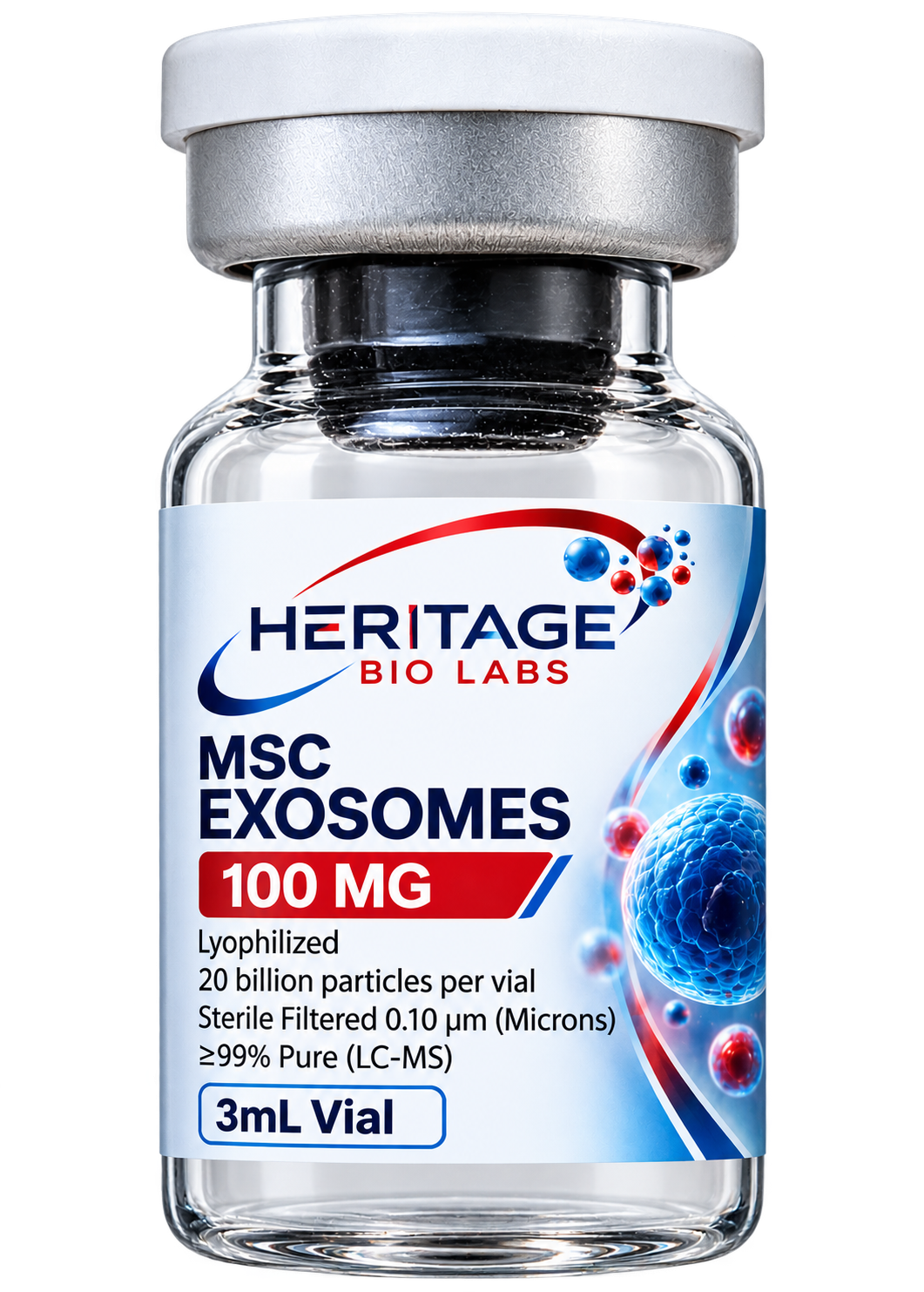
MSC Exosomes — hUC-MSC Derived
$409.00
MSC exosomes are cell-derived extracellular vesicle preparations, not one peptide. Research on human umbilical-cord MSC preparations describes cell-signaling cargo and experimental effects on inflammation, blood-vessel formation, collagen deposition, and wound repair. For research use only; not for human or veterinary use.
What are MSC exosomes?
Educational research context. The cited studies and supplier descriptions do not verify the identity, testing, or effects of this Heritage product.
MSC exosomes refers to small extracellular vesicles obtained from mesenchymal stromal/stem-cell cultures. The additional label hUC-MSC indicates human umbilical-cord-derived cells. These preparations contain heterogeneous biological cargo rather than a single defined peptide sequence, and their identity depends on the source cells and the vesicle isolation and characterization methods. Research descriptions focus on communication between cells through vesicle-associated proteins, lipids, and RNA. The requested name does not establish the composition of a particular commercial preparation. [1,2]
In a 2022 experimental diabetic-wound study, investigators reported that umbilical-cord MSC-derived exosomes promoted wound repair alongside macrophage polarization toward an M2-associated phenotype, increased blood-vessel formation, and collagen deposition. This work involved diabetic rats and cell experiments rather than a clinical trial of the requested product. [1] A separate study reported enhanced proliferation and migration of human skin fibroblasts and endothelial-cell activity in vitro, together with wound-repair effects in skin-wound models. Its authors proposed microRNA-associated regulation of inflammation and tissue repair. [2] These sources explain the regenerative and anti-inflammatory themes attached to MSC-exosome research, but neither identifies a standardized product called “MSC Exosomes 3mL/100mg.” Particle concentration, cargo, and formulation cannot be inferred from that label.
Sources
- hUCMSC exosomes in experimental diabetic wound healingLiterature record (study type requires review)
- Yang et al.—hUCMSC exosomes, inflammation and angiogenesisLiterature record (study type requires review)
For research use only. Not for human or veterinary use; not medical advice.