
Payment Options
 Cash App
 Apple Pay
 PayPal
 Crypto (USDC)
$10 USPS Priority Shipping
Estimated delivery: 2–5 business days. Delivery times may vary.
Orders of $500 or more ship free. Final shipping details at checkout.
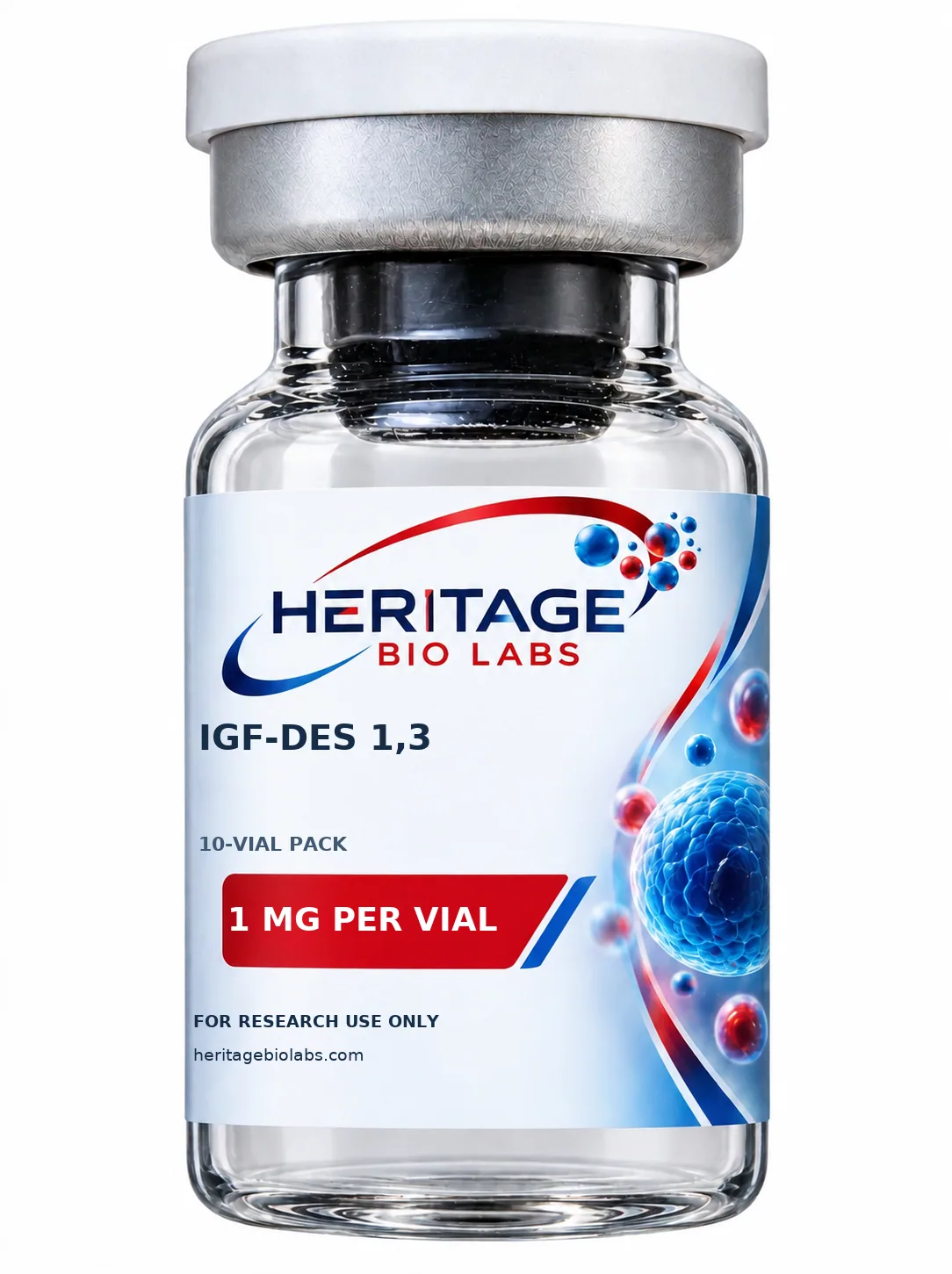
IGF-DES 1,3 — 1 mg per vial (10-vial pack)
$179.99
IGF-DES 1,3 commonly refers to des(1–3)IGF-I, an IGF-1 analogue missing its first three amino acids. Studies describe reduced binding-protein interaction and enhanced activity in selected cell-based experiments. For research use only; not for human or veterinary use.
Pack: 10-vial pack
Full description
Educational research context. The cited studies and supplier descriptions do not verify the identity, testing, or effects of this Heritage product.
The established literature name des(1–3)IGF-I denotes an IGF-I molecule lacking its first three amino-terminal residues. This truncation changes its interaction with IGF-binding proteins, which normally influence how much growth factor is available to receptors. In a 1989 experimental paper, investigators compared IGF-I, IGF-II, and des(1–3)IGF-I in cell systems and found that binding proteins inhibited the intact growth factors more effectively than the truncated analogue. That distinction helps explain why DES material can appear more active in a particular culture environment.
A 1992 study of cultured rat granulosa cells likewise used des(1–3)IGF-I to investigate endogenous binding-protein inhibition. Under binding-protein-rich conditions, the truncated analogue more strongly supported an FSH-associated progesterone response than intact IGF-I. These are defined laboratory outcomes, not a universal potency multiplier applicable to every tissue or species. The shorter requested label “IGF-DES 1,3” does not independently specify an IGF family member, although des(1–3)IGF-I is the recognizable research usage. Product identity should therefore be confirmed as the IGF-I truncation before treating this description as an exact molecular match.
Sources
- Binding proteins and des(1–3)IGF-ILiterature record (study type requires review)
- Rat granulosa-cell study of truncated IGF-IExternal reference (requires review)
For research use only. Not for human or veterinary use; not medical advice.